
Beyond the scale: How smart scales help track metabolic health progress
- 3 days ago
- 4 min read
You’re putting in the work. You’re making mindful food choices, drinking your water, moving your body, and prioritizing rest. That takes commitment, and it matters.
One day, one habit, one pound at a time. Achieving optimal metabolic health doesn’t happen overnight, and some days will test your resolve.
But the results? Transformational.
As you work toward optimal metabolic health, it’s important to track your progress. Self-monitoring is an essential and powerful part of behavior change. It involves tracking your behaviors or outcomes against your goals or past performance.
We’ll help you make sense of the health metrics on your smart scale so you can better understand what the numbers mean.

What is a smart scale and how does it work?
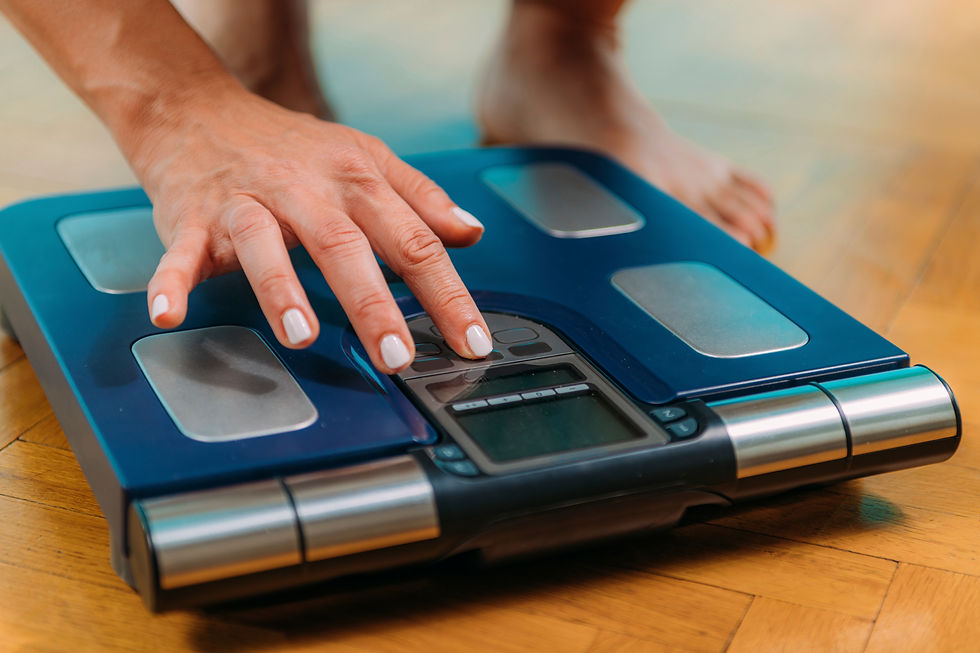
Many people use smart scales at home to track progress. These scales use a measurement technique called bioelectrical impedance (BIA) — a painless, tiny electrical signal that moves through your body to estimate body composition, based on water content.
Because smart scales can provide many different readings — and each scale’s app may label or calculate them a little differently — it’s important to use the scale’s app or resources to understand what the numbers are telling you. These tools can help you interpret key body composition metrics, such as visceral fat, lean mass, and muscle, and focus on trends over time rather than any single measurement.
What to look at (beyond weight).
While weight is an important data point, metabolic health is also evaluated through several key clinical markers. You can work with your healthcare provider to track these key indicators.
Blood pressure: A direct indicator of cardiovascular strain.
Blood glucose (A1C/fasting glucose): Shows how efficiently your body is managing its primary fuel source (carbohydrates).
Cholesterol (HDL/LDL) and triglycerides: Reveals the balance of “good” versus “bad” cholesterol and fat in your blood.
Waist circumference: A simple but great proxy for measuring visceral fat.*
Body composition: The breakdown of your body into major components like fat, lean mass, and bone.*
When measuring just body composition in clinical studies, researchers use “gold standard” imaging like DEXA scans or MRIs. However, more affordable and accessible technologies like smart scales can be used at home to help track your progress over time. We recommend you work with your healthcare provider for personalized health monitoring guidance.
Don't get distracted by daily changes.
As you begin to examine your smart scale data, it can be tempting to overanalyze each day’s results. Learning to look at trends rather than focusing on a single day’s results is important. If your body fat percentage is 32.4% one day and 33.1% the next, that is not necessarily a true gain in body fat.** It’s simply a “data wobble” caused by finicky factors that can temporarily skew your results.
These temporary factors include:
Hydration (this is the biggest factor)
Time of day
Food intake
Skin temperature or recent exercise
Improper positioning on the scale
Clothing
Hormonal fluctuations (especially for women experiencing menstrual cycles)
What actually matters: the trend.
This is the key: look at the trend, not the day. Here’s how to stay grounded in your data:
1. Consistency is key.
Weigh yourself the same way each time — same scale, same time of day, ideally in the morning after using the restroom.
2. Take the 30-day view.
Don’t focus on day-to-day changes. Look at what’s happening over weeks and months.
3. Work with your healthcare provider.
While smart scales and body composition data are helpful for tracking metabolic health progress, some markers require blood work or clinical imaging. Work with your healthcare provider for personalized health monitoring guidance.
Frequently asked questions about tracking metabolic health.
How often should I weigh myself?
It’s important to weigh yourself regularly (same scale, same time of day, same clothes each time). We recommend weighing yourself at least once per week. It’s a personal choice if you would like to weigh yourself more frequently (e.g., daily).
Keep in mind that sometimes your weight and body composition data will change, even on the same day, due to differences in fluid balance, hormones, bowel movements, and other factors.
What technology can I use to track my progress?
Smart scales are an accessible and convenient tool for tracking your progress at home. Many smart scales provide measurements beyond weight, such as body fat percentage, muscle mass, and other body composition metrics.
Do I need expensive equipment to track my health?
No, you don't need expensive equipment. Smart scales are available at a variety of price points and can provide valuable insights into changes in your weight and body composition over time. The most important factor is consistently tracking your progress, looking at the trends over time, and discussing any health concerns with your healthcare provider.

Keep moving forward on your health journey.
Achieving optimal metabolic health is a journey, not a sprint. Be patient with yourself and trust the process.
A strong approach brings together thoughtful nutrition, consistent habits, and tools that support behavior change in a way that fits your life.
As you move forward, remember this: progress isn’t defined by a single number or a single day. It shows up in the patterns you build and the consistency you maintain over time.
When you combine smart tracking tools with a broader view of your health, you gain clarity — and with that clarity comes confidence.
Celebrate the small wins. Stay curious about your data. And keep showing up for yourself.
Because over time, those daily choices add up to meaningful, lasting improvements in your metabolic health.
*In a clinical study, individuals on the OPTAVIA® 5 & 1 Plan® experienced a reduction of 14% visceral fat and 98% of lean mass was retained at 16 weeks,
Arterburn LM, Coleman CD, Kiel J, et al. Randomized controlled trial assessing two commercial weight loss programs in adults with overweight or obesity. Obes Sci Pract. Feb 2019;5(1):3-14. doi:10.1002/osp4.312.
**Those on the Optimal Weight 5 & 1 Plan with support of an OPTAVIA coach successfully lost 10x more weight and 17x more fat than those who tried to lose weight on their own.


Comments